

Delta Waves and Deep Sleep: What the Science Actually Shows

Brain.FM
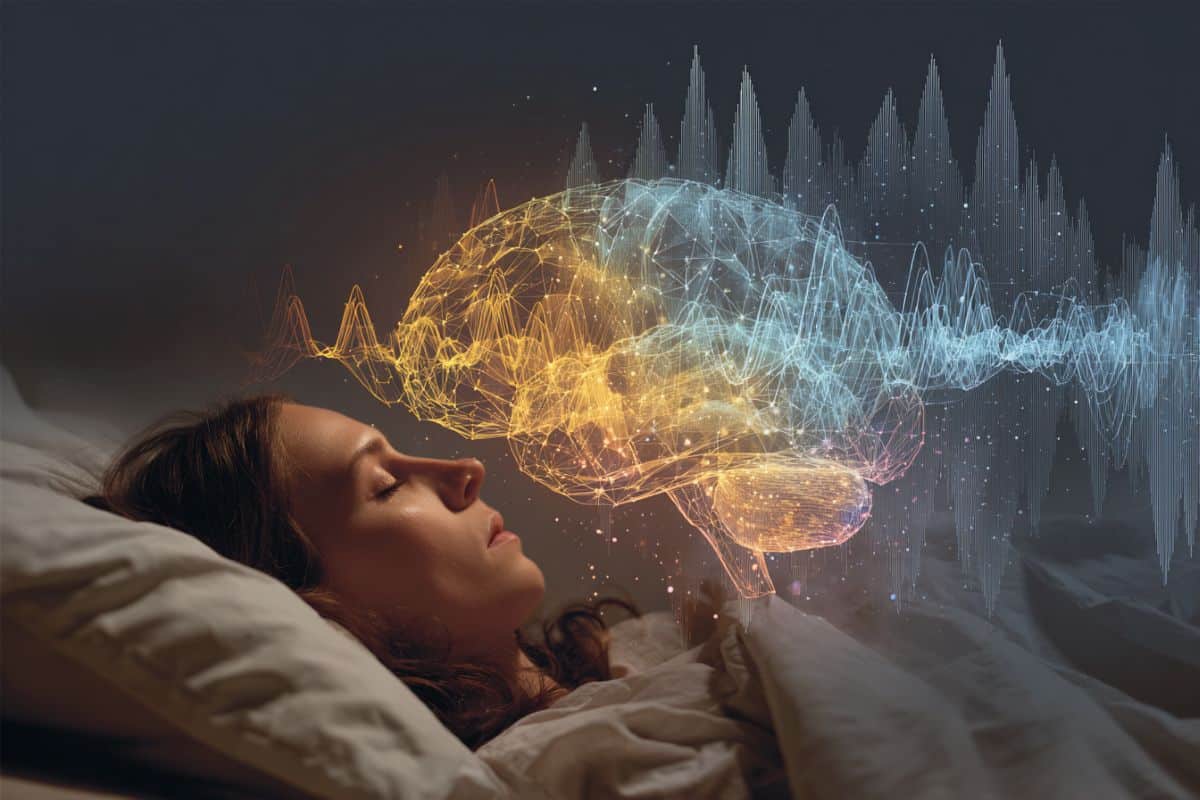
Delta waves and deep sleep go hand in hand. When you drift into the deepest stage of the night, your brain slows into large, rolling electrical waves called delta waves, and this is the sleep that leaves you feeling genuinely restored the next morning. It is also the stage most people get too little of.
So what do delta waves actually do, how much deep sleep do you really need, and can anything help you get more of it? The honest answer is that the science here is fascinating, fast-moving, and in a few places still being argued over by serious researchers. This article walks through what the evidence supports, what is still uncertain, and what you can do about it tonight.
What delta waves and deep sleep actually are
Your brain is always producing electrical activity, and scientists sort that activity into frequency bands measured in hertz (cycles per second). Delta waves are the slowest of these, sitting roughly between 0.5 and 4 Hz. They are the signature of deep sleep, which sleep scientists call slow-wave sleep, or stage N3 of non-REM sleep.
During slow-wave sleep, huge populations of neurons switch on and off together in a slow rhythm. Researchers describe these as "Up states" of activity and "Down states" of near silence, cycling at that delta frequency. It is the most synchronized your brain gets all day, which is part of why deep sleep looks so distinctive on an EEG and why these deep sleep brainwaves are such a useful marker of sleep quality.
Two things often get blurred here. First, the term "delta waves" is sometimes used loosely to mean all slow sleep activity, but recent research draws a line between true delta waves (around 1 to 4 Hz) and slower "slow oscillations" below 1 Hz, and the two appear to do different jobs. Second, deep sleep is only one slice of the night. In healthy adults it usually makes up somewhere around 13 to 23 percent of total sleep, it is concentrated in the first half of the night, and it shrinks steadily as we age.
So when people talk about delta waves sleep, they are really talking about the quality and quantity of this early, deep, restorative phase. Get that part right and the rest of the night tends to follow.
What your brain actually does during deep sleep
Deep sleep does real work. It is when several of the body's most important maintenance jobs get done, and three of them stand out. Each is worth understanding honestly, including where the science is still developing.
It is worth separating deep sleep from REM sleep here, because trackers and headlines often lump them together. REM sleep is the dreaming stage, and it leans toward emotional processing and creative connections. Deep, delta-rich slow-wave sleep is more about physical and structural restoration. You cycle through both several times a night, but they are not interchangeable, and the deep-sleep jobs below are specific to the delta stage.
It helps lock in memories
One of the best-supported roles of slow-wave sleep is memory consolidation, the process of moving fresh memories into more stable long-term storage. Deep sleep is when the brain appears to replay and strengthen what you learned during the day.
The detail that matters, and that most articles skip, is which slow waves do the work. The very slowest activity, the sub-1 Hz "slow oscillations," is what studies have tied to stronger memory, and enhancing those rhythms after learning has improved recall in controlled experiments. Faster delta waves are more complicated. A landmark 2019 study using precise optogenetic methods in animals found that slow oscillations and delta waves can pull in opposite directions, with slow oscillations favoring consolidation and some delta waves linked to forgetting. More recent work in 2024, using rare samples of living human brain tissue, showed that these slow waves shape how strongly neurons connect during deep sleep.
For a general reader, the practical point is simple. The orchestrated pattern of a full deep-sleep cycle is what supports healthy memory, and you do not need to micromanage any of it. You just need enough uninterrupted deep sleep for the process to run.
It drives physical recovery
Deep sleep is also when a lot of physical repair happens. The body's largest and most reliable pulse of growth hormone is released shortly after you fall asleep, timed to your first stretch of slow-wave sleep. That opening pulse is often the single biggest burst of growth hormone in the whole day, and the amount released tracks closely with how much slow-wave sleep you actually get.
Growth hormone helps the body repair tissue and maintain muscle, and it plays a part in metabolism too. As deep sleep declines with age, this nightly pulse shrinks too, which is one reason recovery can feel slower over the years. It is a good argument for protecting the early, deepest part of your night rather than treating sleep as something to trim.
It may help with brain housekeeping
You may have read that deep sleep is when the brain "washes itself." This refers to the glymphatic system, a network that moves cerebrospinal fluid through brain tissue and is thought to clear metabolic waste, including proteins linked to Alzheimer's disease. Several studies connect this clearance to slow-wave sleep.
This is an area to describe carefully. In 2024, one research group reported that brain clearance looked reduced, not increased, during sleep in mice, which kicked off an active and still-unresolved scientific debate. Other leading labs have pushed back hard on the methods, and the question is far from settled. So the cautious summary is this: deep sleep is strongly associated with brain maintenance and long-term brain health, the exact mechanism is still being worked out, and competing models are being tested right now. That uncertainty does not change the practical advice, because protecting your deep sleep is sensible either way.
Why deep sleep gets harder to come by
If it feels like you are not getting enough deep sleep, you are probably right. Several everyday factors chip away at it:
Age. Slow-wave sleep naturally decreases from young adulthood onward, and can nearly disappear in older age.
Alcohol. A nightcap may help you fall asleep, but it tends to suppress and fragment deep sleep later in the night.
Late caffeine. Caffeine has a long half-life and can quietly reduce sleep depth even when you still manage to fall asleep.
Stress and a busy mind. A revved-up nervous system keeps you parked in lighter stages.
Irregular schedule. Going to bed at a different time each night blunts the strong early push into deep sleep.
Evening light and screens. Bright light late at night delays your body clock.
Untreated sleep disorders. Conditions like sleep apnea repeatedly pull you out of deep sleep and are worth raising with a doctor.
The encouraging part is that most of these are things you can influence, starting tonight.
How to protect and deepen your sleep
No single trick reliably manufactures deep sleep, but a stack of good habits gives your brain the best possible chance to produce it.
Keep a consistent schedule. The same wake time every day, weekends included, is one of the strongest levers you have.
Get morning light. Early daylight anchors your body clock and strengthens your sleep drive that night.
Keep it cool and dark. Your body needs to drop its core temperature to reach deep sleep, so a cooler room genuinely helps.
Watch alcohol and late caffeine. Both are common and very fixable deep-sleep thieves.
Build a real wind-down. Give your nervous system 30 to 60 minutes to downshift before bed.
Move during the day. Regular exercise is consistently linked to more slow-wave sleep.
Sound is one more lever worth knowing about. In controlled studies, carefully timed audio played during sleep, known as closed-loop acoustic stimulation, can reliably increase slow-wave activity, although its effect on next-day memory has been more mixed across trials. This is the research space where purpose-built sleep audio lives, and it is a world away from putting on a random playlist.
If your wind-down could use help, this is a good moment to try functional music made for sleep instead of generic background tracks.
Where Brain.fm fits in
Brain.fm makes functional music, meaning audio engineered for a specific mental state rather than for entertainment. Its Sleep music uses a patented approach the company calls Phase-locking Neural Modulation, which adds precise modulations to the music intended to encourage neurons to coordinate their activity and settle into the patterns of deep sleep.
That is the claim, so here is the honest evidence behind it. In a small pilot funded by the National Science Foundation, three subjects showed a 24 to 29 percent increase in delta wave activity on nights they listened to Brain.fm compared with nights they did not, alongside brain-activity markers associated with slow-wave sleep. That is an encouraging early result rather than a large clinical trial, and Brain.fm is upfront that the effect is meant to be steady and subtle rather than dramatic.
The broader point sits on firmer ground: sound can influence sleep depth, and audio built specifically for sleep is a more sensible tool than ambient noise if your goal is to support the deep, delta-rich part of your night.
The bottom line
Delta waves and deep sleep are the foundation of a night that actually restores you. This is the stage where memories settle and the body does its deepest physical repair. You cannot force it into existence, but you can protect it with a steady schedule, morning light, a cooler room, fewer late drinks, and a genuine wind-down.
If you want to give your brain a nudge toward deeper rest, Brain.fm's Sleep music is built for exactly that. Start a free trial, put it on during your wind-down tonight, and let your deep sleep do the work.
Start your free Brain.fm trial and sleep deeper tonight.