

Brain.fm Review 2026 - Does It Actually Work? An Honest Look After 30 Days

Brain.FM
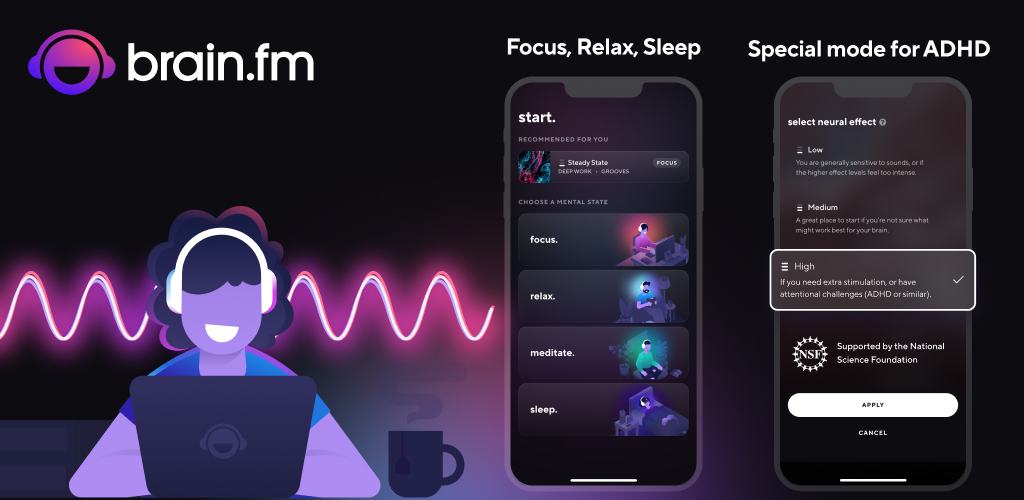
I've tested dozens of focus tools over the years, Pomodoro apps, website blockers, white noise generators, lo-fi YouTube streams, binaural beats playlists. Most of them helped a little, for a while, before fading into the background noise of my productivity tool graveyard.
Then I tried Brain.fm. And unlike most tools I test for a week and forget about, this one stuck. I've now been using it daily for over 30 days, and I tracked everything: how many deep work sessions I completed, how long it took to fall asleep, and whether my ADHD brain actually noticed a difference.
Here's what I found, the good, the bad, and whether Brain.fm is worth your money in 2026.
What Is Brain.fm, Exactly?
If you haven't encountered Brain.fm before, here's the quick version: it's a web and mobile app that streams music specifically engineered to help you focus, relax, or sleep. But calling it "music" undersells what's happening under the hood.
Brain.fm uses a patented technology called neural phase locking. In plain terms, the audio contains carefully designed rhythmic patterns, amplitude modulations embedded directly in the sound, that encourage your brain's electrical activity to synchronize into states associated with sustained attention, relaxation, or deep sleep.
This is fundamentally different from a Spotify "focus playlist" or a binaural beats track. Regular music is composed to be engaging and memorable, catchy hooks, dynamic shifts, emotional peaks. That's great for enjoyment but counterproductive for focus, because those elements pull your attention toward the music and away from your work.
Brain.fm's audio is composed by real musicians and then layered with scientifically calibrated modulations that your conscious mind doesn't really notice but your brain responds to. The result sounds like pleasant ambient, electronic, or acoustic music, but it's doing something specific to your neural activity that a lo-fi hip hop stream simply isn't.
And this isn't just marketing speak. A 2024 peer-reviewed study published in Nature's Communications Biology, conducted in collaboration with Northeastern University's MIND Lab and funded by the National Science Foundation, found that Brain.fm's modulated music produced significantly greater activation in brain networks associated with attention and cognitive control compared to unmodulated control music and pink noise. Participants with higher ADHD symptom scores showed the greatest benefits.
The Onboarding Experience
Signing up is straightforward. Brain.fm offers a 7-day free trial (no credit card required for the initial 3-day window; some promotions extend this to 7 days). During setup, you take a brief quiz about your typical focus challenges, music preferences, and whether you identify as having ADHD or attention difficulties.
Based on your answers, Brain.fm assigns you a "neurotype" that determines the default intensity of the neural effect in your audio. This is one of the most thoughtful onboarding flows I've seen in a productivity app, it's quick, relevant, and immediately makes the product feel personalized rather than generic.
Once you're in, the interface is clean and minimal. You choose a mode (Focus, Relax, Sleep, or Meditate), select a genre or vibe (lo-fi, cinematic, electronic, acoustic, nature, classical, and more), and press play. That's it. No playlist curation, no algorithm anxiety, no decision fatigue. One click and you're working.
Focus Mode: Where Brain.fm Earns Its Keep
Let's start with the reason most people consider Brain.fm: the focus mode. This is the core product, and it's where I spent about 80% of my time during the 30-day test.
Within the focus mode, you can choose sub-categories like Deep Work, Creative Flow, or Light Work. You can also select a genre, adjust the "neural effect" intensity from low to high, and set a timer, including a built-in Pomodoro mode with customizable work and break intervals.
Here's what I noticed: the first few sessions felt... fine. Pleasant background music. Nothing earth-shattering. But when I looked back at those first sessions, I realized I'd worked for 90 minutes straight without checking my phone once. That almost never happens for me.
By the end of the first week, the pattern was unmistakable. On days I used Brain.fm, I consistently completed three to four deep work blocks of 45 to 60 minutes each. On days I didn't (or used Spotify instead), I averaged two blocks with more frequent interruptions.
The key difference isn't that the music feels magical in the moment. It's that you don't notice it. There are no hooks to grab your attention, no sudden volume shifts, no lyrics competing for your language processing. It creates what I can only describe as a cognitive scaffolding, your attention has something steady to rest on, and your focus doesn't drift because the audio isn't asking anything of you.
For context, I have ADHD (diagnosed in adulthood), and I've historically struggled with sustained attention on tasks that don't provide immediate feedback loops. Brain.fm's higher neural effect settings were noticeably more effective for me than the lower ones. The app's recommendation for ADHD users to try higher intensity settings aligns with the research suggesting that ADHD brains benefit from stronger rhythmic stimulation to achieve optimal arousal levels.
Sleep Mode: Surprisingly Effective
I'll be honest, I was skeptical about the sleep mode. I've tried white noise machines, rain sounds, sleep meditations, and melatonin. Most things help a little; nothing has been transformative.
Brain.fm's sleep mode uses a technique called 3D spatialization, which creates a gentle sense of auditory motion, almost like being rocked. The first night I tried it, I set a 30-minute timer and fell asleep before it ended. That might not sound impressive, but for someone who typically lies awake for 20 to 40 minutes processing the day, cutting that to under 15 minutes was significant.
Over the 30-day test, I used sleep mode about four nights per week. My average time-to-sleep on those nights dropped noticeably compared to my baseline. I won't overstate the effect, it's not a cure for insomnia, and factors like screen time and caffeine still matter enormously. But as one piece of a sleep hygiene routine, it's genuinely useful.
The infinite play option is nice for people who wake up during the night, though a few users on Google Play have reported occasional bugs with infinite mode on Android. On iOS and web, I didn't encounter any playback issues.
Relax and Meditate Modes: Solid, Not Standout
The relax mode is pleasant and does what it promises, it's a nice way to decompress after an intense focus session or wind down at the end of the day. I used it a few times during lunch breaks and found it more calming than my usual approach of scrolling social media (low bar, I know).
The meditate mode offers both guided and unguided sessions. The unguided meditation audio is excellent, non-distracting, subtly supportive, and easy to breathe with. The guided session library is more limited. If you're already invested in meditation apps like Headspace or Calm, Brain.fm's meditation offering won't replace them. But if you just want unguided background audio for a breathing practice, it's well done.
The ADHD Use Case: Real Results, With Caveats
This deserves its own section because it's become one of Brain.fm's most compelling use cases, and one backed by actual peer-reviewed research, not just testimonials.
The 2024 Communications Biology study specifically examined how participants with higher ADHD symptom scores responded to Brain.fm's modulated music. Using fMRI and EEG, the researchers found that the music increased blood flow to attention-related brain regions and produced stronger stimulus-brain coupling in participants with attention difficulties. Those participants performed significantly better on sustained attention tasks when listening to heavily modulated tracks.
Brain.fm now offers ADHD-specific tracks and recommends higher neural effect intensity settings for users who self-report attention challenges. In my experience, the higher settings made a meaningful difference. The medium setting felt like pleasant background music; the high setting felt like my brain had something to latch onto, and staying on task became significantly easier.
Important caveat: Brain.fm explicitly states it is not a treatment for ADHD or any other medical condition. They haven't conducted clinical trials with formally diagnosed ADHD populations. Their research measured self-reported ADHD symptom scores, not clinical diagnoses. If you have ADHD, Brain.fm should be considered a complementary tool alongside whatever treatment plan you have with your healthcare provider, not a replacement.
Pricing: Is It Worth the Subscription?
As of 2026, Brain.fm offers two plans:

Both tiers include unlimited sessions, all modes, offline access on mobile, and personalization features. The annual plan comes with a 60-day money-back guarantee. Student discounts (20%) are available by emailing support from a .edu address.
Is it worth it? Here's how I think about it: if Brain.fm saves you even one hour per week of wasted time from distraction or poor focus, the annual plan pays for itself many times over. At roughly $8.33 per month, it costs less than a single fancy coffee, and unlike caffeine, the effects don't come with a crash.
That said, it's a recurring subscription in a world where everyone already has too many. If you're someone who can focus well with a free white noise app or Spotify playlist, Brain.fm might not offer enough incremental benefit to justify the cost. The free trial exists precisely for this reason, try it and see if the difference is noticeable for your brain.
Pros and Cons After 30 Days
What I loved:
The single-click simplicity, no playlist hunting, no algorithm management. Just press play and work. The science is legitimate. A peer-reviewed study in a Nature journal, an NSF grant, and patented technology set this apart from competitors making vague "scientifically designed" claims. Focus mode genuinely improved my sustained attention, especially with higher neural effect settings. The Pomodoro timer integration eliminates the need for a separate timer app. Offline access on mobile means I can use it on flights or in areas with poor connectivity. The sleep mode exceeded my expectations for reducing time to fall asleep.
What could be better:
The music library, while large, can start to feel repetitive if you use a single genre heavily for weeks. I found myself rotating between genres to keep things fresh. No desktop offline access, mobile only for downloads. The motivational quotes on the Pomodoro timer can't be customized, and some feel generic. The meditate mode's guided session library is thin compared to dedicated meditation apps. Pricing information on the website could be more transparent upfront.
Brain.fm vs. the Alternatives
How does Brain.fm compare to other options?
Against Spotify or YouTube focus playlists, Brain.fm wins on consistency and science. Regular music is designed to engage your attention; Brain.fm is designed to support it without stealing it. The difference is subtle but measurable, and it compounds over long work sessions.
Against Endel, Brain.fm's closest competitor, the differentiator is research depth. Brain.fm has peer-reviewed studies, NSF funding, and published papers. Endel uses adaptive sound technology that's well-designed but has less publicly available research validation.
Against white noise or brown noise, Brain.fm offers a more pleasant listening experience with potentially stronger cognitive effects. Research suggests white noise can help ADHD brains, but roughly a third of people with ADHD actually perform worse with it. Brain.fm's targeted modulations appear to be more consistently effective.
Against binaural beats, Brain.fm uses a fundamentally different and more robust mechanism. Binaural beats rely on a perceptual illusion that produces weak neural synchronization. Brain.fm embeds modulations directly into the audio, producing stronger and more reliable effects on brain activity.
The Bottom Line: Does Brain.fm Actually Work?
Yes, with the understanding that "work" doesn't mean magic. Brain.fm isn't going to fix your focus if you're sleep-deprived, overwhelmed, or trying to multitask. What it does is create an optimal auditory environment for sustained attention, one that's backed by real neuroscience and feels noticeably different from any playlist or white noise generator I've used.
After 30 days, I've renewed my annual subscription. It's become as much a part of my work routine as my morning coffee. The best productivity tools are the ones you don't think about, you just turn them on and get to work. Brain.fm is that kind of tool.
If you're curious, start with the free trial. Give it at least a week of consistent use (the effects seem to strengthen with regular listening). Try different genres, experiment with the neural effect slider, and use it during actual work sessions, not just casually in the background.